
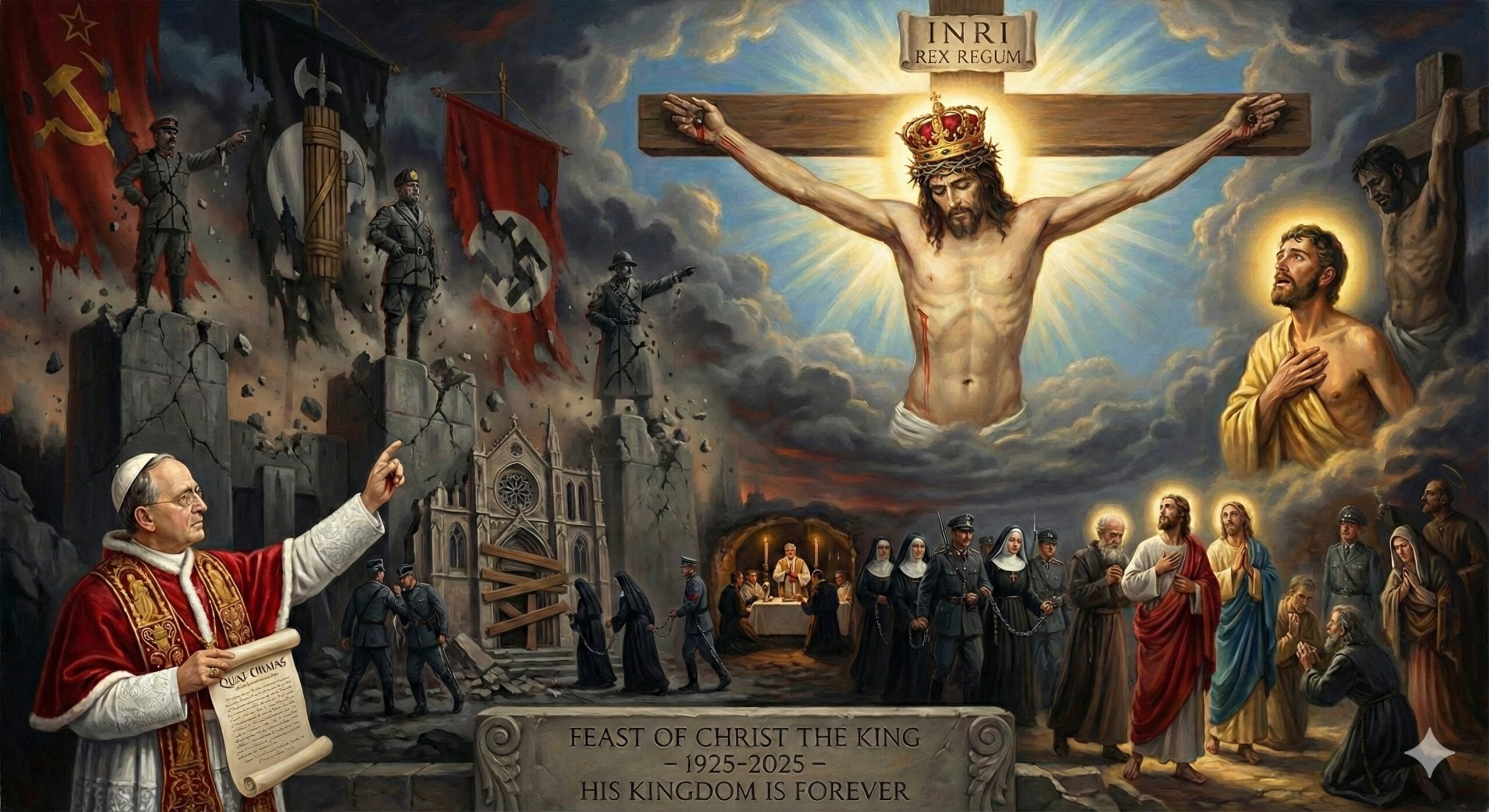
This Feast of Christ the King is one hundred years old today. We are celebrating the anniversary of it being instituted. Many of the feast days of the church have been instituted for hundreds if not thousands of years, but this is a rather new one. It’s very interesting. If you can think back to 1925, what was happening in the world around that year? The end of the First World War was just happening. What would happen about 15 years later? World War II. I want to set the framework, that it was a very, very turbulent time in the world.
After World War I had come to an end, many nations were still broken, they were still poor, they were still recovering. The Holy Father saw that there began to be stirrings of something that did not look good. He saw people rising to power that were not really good people. He instituted the Feast of Christ the King to remind people that no person on earth, no government on earth, no system on earth is Christ. Only Christ is the King.
While he was writing this, these are some of the things that he started to see that were stirring in our world. To begin with, I’ll name the place and you tell me what was happening there. Soviet Union. What was happening then? Communism. In Communism, it’s a state where the entire people are controlled by the state. The state delegates everything: economy, speech, even beliefs. And one of the sole goals of Communism was to wipe out any religion. A couple of the big names back then were Lenin and Stalin. Lenin would say, “We must combat religion. This is the ABC of our materialism.” Stalin would say, “We will mercilessly destroy anyone who, by deed or thought or belief, threatens the unity of this socialist state.”
During that time, there would be much persecution, and especially for the Catholic faith, the churches would be seized. They would be destroyed. Bishops, Priests, Monks, Nuns would be arrested, executed, and sent to the Gulag camps. All Catholic worship, sacraments, and catechesis was outlawed, families were punished for baptizing their children, and the Church that we have talked about before, had to go underground. The sacraments were celebrated in secret.
The Holy Father’s answer at that time was, “The rebellion of individuals and states against the authority of Christ has produced deplorable consequences.”
Then, throughout all of Europe, and we are experiencing this now in the United States today, there was a secular socialism. The rise of secularism could be described as government expanding control over society, pushing religion out of public life, not usually violent, but not good either. This would affect France, UK, Germany, and Scandinavia.
Some of the quotes that were said during that time were, “We are determined to end the influence of clergy and public life.” Another one was, “Religion has no place in the machinery of government.” During that time, all Catholic schools were restricted or banned. All crosses were removed from any classroom. Hospitals, charities and all universities were secularized, stripped of any Catholicism, and Faith was reduced to a private matter. People were supposed to divorce any faith from the workings of the government.
The Holy father responded to that by saying, “It would be a grave error to say that Christ has no authority whatsoever in civil affairs.” And, I see that happening today. I’ve heard a lot of even Catholics say, “Father, separation of church and state.” What we have to remember is separation of church and state was to protect the church from being overcome and oppressed by the state. Separation of church and state is so that religion can flourish in our country. It was never meant to say keep your faith out of politics. No, politics ought to shape our faith because it is based on Christian values.
Okay, so these are all isms by the way, just know if you hear an ism, it’s probably bad. In Italy, what was going on at that time? Fascism, right? Who was the leader? Mussolini. He would say, “Everything within the state. Nothing outside the state, and nothing can be against the state. This Fascist state accepts no authority outside of its own.” So, there would be this national dictatorship demanding unquestioned obedience, honor and even worship to the state figures.
During that time, the Catholics would begin to be persecuted again. Priests were monitored, censored, and threatened. All Catholic papers were suppressed. The state attempted to replace the church with the state being the sole author of moral authority.
The Holy Father at that time would say, “Rulers and Princes are bound to give public honor and obedience to Christ, not to the state or any person.”
What ism was in Germany? Nazism was at that time. Nazism was a completely racist, totalitarian ideology demanding worship of the nation and of its leader. The main leader of this was? Hitler. A couple of things were said at that time. “Nationalism and Christianity are irreconcilable.” You can’t have the two. “The Catholic Church is the greatest enemy of the German people.” That would be said as well. We know that, at that time, the whole world would experience the largest holocaust that we have ever experienced where they tried to exterminate the Jews. Just behind the Jews were the Catholics. All Catholic schools were closed. Religious education was banned. Youth groups were dissolved, replaced by Hitler’s youth. Priests were arrested and tortured, over 2700 priests were sent to Dachau alone. Their sermons were monitored, priests were imprisoned and criticism was punishable by death.
The Holy Father responded, “His Kingdom embraces all men without exception.”
At that time, we were experiencing the greater ism, which is totalitarianism, where the whole world across many of these European countries, the government or political leaders, began to be worshipped. They were seen as being the savior, and if you handed everything over to the state, they would take care of you.
This all would happen during the events that the Holy Father saw when he made the Feast of Christ the King. And again, it would be shortly after World War I. But all of these stirrings, all of these isms, would lead to World War II.
The Holy Father said, “When once men recognized both in private and public life that Christ is the King, then society will at least receive the blessing of real liberty, a well-ordered discipline, peace, and harmony.” So, why did he institute this Feast of Christ the King? As I said, these states, these countries were more and more proclaiming that the state would replace God. That the leaders of the state would be saviors, that the party of the state is the truth, and that this power and authority was to be the ultimate power and authority over the people.
These are the things that we experienced 100 years ago. It’s interesting that we are experiencing some of this 100 years later. In each and every one of us there is probably a lot of mixed emotions going on in our hearts, born out of concern for our country, and our world. There’s probably a lot of fear about what may happen. It’s important that we remember that Christ is the King.
Today, He shows us His Kingship, that He would rule from the crucifix. He would rule by taking on all suffering, taking on all sin, and dying at the hands of people who were corrupt. It was not to end in death, because He would also rise in glory, ascend in glory, and give us the gift of the Holy Spirit.
Imagine what it must have been like. Jesus was crucified and on his left and right are two thieves. They are crucified next to him. The bad thief is known to be the one on the left, and the good thief is known to the one on the right. Why are they bad and good? The bad thief doesn’t know who this is, he questions who Jesus is. He says, “If you are the Son of God, save me and save ourselves.” First of all, he says, “If you are.” He doesn’t believe that he is. “Save yourself and save all of us.” The good thief, on the right, says to him, “Have you no fear of God, for you are subject to the same condemnation? Indeed, we have been condemned justly.” He realizes his sin. “We have been condemned justly for the sentence we received corresponds to our crime. But this man, [Jesus], has done nothing wrong.” And then he says these powerful words to Jesus. First of all, he’s acknowledging who Jesus is, and he’s acknowledging that Jesus is King. These are the words that he says: “Jesus, remember me when you come into your Kingdom.” Jesus – he knows who Jesus is. “Remember me when you come into your kingdom.”
And then, part of me wishes I was that thief on that crucifix, because Jesus says to him, “Amen, I say to you, today you will be with me in Paradise.” That thief who was guilty of the sin and crucified, Jesus said to him, “Today you will be with me in Paradise.” He became the first saint that there ever was. And it was because of Jesus’ love and mercy.
As we celebrate this feast day of Christ the King, may we remember that beyond any political party, beyond any power in the world, beyond any government or worldly authority, Christ is our King. If we can be like the good thief, and acknowledge our own guilt. If we can remember that Jesus, ‘remember me,’ and say that to him many times throughout the day, ‘Jesus remember me when you come into your kingdom,’ that he could say to each and every one of us, “Today, you will be with me in Paradise.”